


How Rhythmic Illustrated Children’s Books Support Child Development
A young child may not understand every word in a story, but they often understand the beat. They lean into repeated sounds, point at bright pictures, clap along to a rhyme, or ask for the same page again and again. That repetition can feel simple to an adult. For a child, it is doing real work.
Rhythmic illustrated children’s books bring together two powerful tools: sound and visual meaning. The rhythm helps children hear language patterns. The illustrations give them clues, emotions, and context. Together, they turn reading into a full-body experience that supports speech, attention, memory, emotional growth, and a warm bond with the adult who reads aloud.
Children do not need long lessons to benefit. A few minutes with a well-paced picture book can invite them to listen, predict, respond, move, and connect.

Rhythm helps children hear how language works
Before children can read words on a page, they learn to hear language. They notice sounds, pauses, patterns, and musical changes in a voice. Rhythmic books make those patterns easier to catch.
A line like “tap, tap, tap went the tiny red shoes” invites a child to hear repeated sounds. A rhyming pair such as “moon” and “spoon” helps them notice that words can end the same way. A repeated phrase gives them a chance to join in before they can read.
This matters because early language learning is not only about vocabulary. It is also about sound awareness. Children begin to understand that words are made of smaller sounds. Later, that awareness supports reading skills.
Rhythm also gives children a natural sense of sentence flow. They hear where a phrase begins and ends. They feel the difference between a question, an exclamation, and a quiet statement. A lively read-aloud voice can make these differences clear without formal teaching.
For example, a book with a refrain such as “Round and round, up and down” lets a child hear:
Repeated word patterns
Similar ending sounds
Changes in pace
Natural pauses
The musical rise and fall of speech
These are small moments, but they add up. A child who hears language often, and hears it with rhythm and joy, gets more chances to build the listening skills that reading will later depend on.
Illustrations turn words into meaning
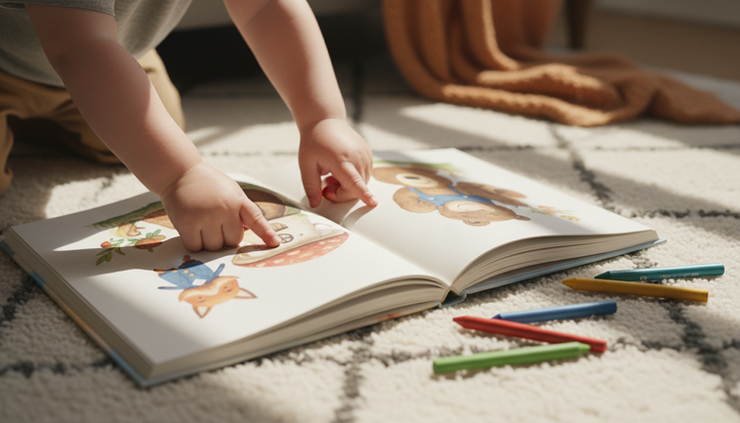
Pictures do more than decorate a children’s book. They help children connect spoken words to real ideas.
If a story says, “The bear tiptoed through the snow,” the illustration might show the bear lifting one paw, snowflakes falling, and a quiet forest around it. Even if the child does not fully understand “tiptoed,” the picture offers clues. The child can see that the bear is moving carefully.
This is especially helpful for younger children, children learning more than one language, and children who are still building vocabulary. Illustrations make abstract language more concrete.
A good picture can show:
Setting
Emotion
Action
Size and shape
Cause and effect
Relationships between characters
When adults pause to talk about images, children get even more from the book. A simple question like “What do you think the rabbit is feeling?” invites a child to study faces and body language. That builds emotional understanding as well as vocabulary.
Illustrations also support memory. Children may remember the page with the giant yellow moon or the tiny blue boat before they remember the exact words. The image becomes an anchor. When the adult reads the story again, the child connects the remembered picture to the repeated language.
That connection is one reason rhythmic illustrated books are so satisfying. The child hears a familiar line, sees a familiar image, and feels the pleasure of knowing what comes next.
Comments